How to Translate Course Guide
 Add to Chrome
TABLE OF CONTENTS
The internet is full of excellent course materials — MIT OpenCourseWare, Stanford lectures, top university syllabi. But if you don’t read English fluently, these resources feel locked away. You find a perfect course on machine learning or economics, but the 20-page syllabus is too overwhelming to read through.
The good news: with 10–20 minutes of smart translation, you can unlock these materials and learn from the world’s best courses in your own language.
Who is this guide for?
Whether you’re a self-learner pursuing new skills, a student looking for supplementary materials, or an educator researching course designs — if you’ve found excellent educational content in English but struggle to understand it fully, this guide will help you bridge that gap.
1. Why translate course guides?
Imagine finding Stanford’s machine learning course online. The lectures, problem sets, and exams are all available. But the 30-page course guide is in dense academic English. You could muddle through and catch maybe 60% of the meaning, or spend 20 minutes translating it properly and understand 95%.
When you can read “This course covers Bayesian inference, MCMC methods, and variational approaches” clearly in your own language, you immediately know whether it matches your goals and background.
What translation gives you:
- Access to world-class education — The best courses are often from MIT, Stanford, and Harvard. Translation unlocks all of them.
- Clear learning path — Know what topics are covered, in what order, and why.
- Ability to follow along — Understand which readings are required, what assignments test which concepts.
- Time saved — Stop hunting for materials in your language. Translate the best English resources directly.
- Focus on content — Your mental energy goes into understanding the subject, not parsing English sentences.
2. What to look for before translating
Spend five minutes identifying the sections that matter most. Not every paragraph needs equal attention.
Course description and objectives — Is this course right for your level? A course titled “Introduction to Statistics” might actually target graduate students with calculus background.
Prerequisites — Critical for self-learners. “Students should be comfortable with linear algebra” versus “Familiarity with calculus is helpful” are very different requirements.
Schedule and topics — Your learning roadmap. Shows which concepts are foundational and how everything connects.
Readings and materials — Can you actually access the textbooks and papers? Are they free or behind paywalls?
Assignments and exams (if available) — Shows the mathematical level and whether it’s theoretical or applied.
Grading breakdown (if taking for credit) — Helps you prioritize effort realistically.
3. How to translate efficiently
Course guides can be 10–30 pages. Work smart, not sequentially.
Start with the overview
Translate just the table of contents or weekly schedule first (2–3 minutes). You’ll see topics like “Week 3: Hypothesis Testing” in your language and immediately know if this course fits.
If weeks 1–4 cover material you already know, skip translating those sections and focus on the new content. Or you might discover the advanced topics you want start in week 10, but the first nine weeks build essential foundations.
Choose tools strategically
For complete documents: Use ChatGPT or Claude. Upload the PDF and provide context:
“I’m a self-learner interested in data science. Please translate this course syllabus into Spanish and explain the course structure, key topics, and prerequisites.”
These tools maintain formatting and can explain technical concepts as they translate.
For specific sections: Use OpenL or Google Translate for quick paragraph-level translations. OpenL is optimized for educational content and preserves academic terminology accurately.
Tool comparison:
| Tool | Best For | Strengths | Limitations |
|---|---|---|---|
| ChatGPT/Claude | Complete documents | Explains context, maintains formatting | File size limits, may need subscription |
| OpenL | Course materials, academic text | Preserves technical terms, natural phrasing | Focused on education domain |
| Google Translate | Quick checks, rare languages | Fast, 100+ languages, free | Sometimes awkward phrasing |
For technical content: Always include context. Don’t translate “The kernel operates on the input space” alone. Include the full paragraph so the tool knows whether “kernel” refers to mathematics, computing, or something else.
Save both versions: Name files clearly (e.g., “MIT_6.036_ML_Spanish.pdf”) and keep the English original nearby for reference.
4. Review and truly understand
Machine translation is your first draft. Now make sure you genuinely understand it.
Self-check questions:
- What is this course mainly about?
- What are the 3–5 main topics?
- What should I be able to do by the end?
Create a learning roadmap — Simple table format:
| Week | Topic | Required Readings | Assignment | Notes |
|---|---|---|---|---|
| 1 | Introduction to Probability | Chapter 1, pp. 1-24 | Problem Set 1 | Review basic calculus first |
| 2 | Random Variables | Chapter 2, pp. 25-48 | Problem Set 2 | Key: expectation, variance |
List knowledge gaps: Which concepts are completely new? Which terms don’t you understand even in your language? Note these to research separately.
Success test: Can you explain what you’ll learn, in what order, and what you need to know first? If yes, you’re ready to start.
5. Common translation traps
Technical terminology
Keep English terms with translations in parentheses: “backpropagation (反向传播)” or “backpropagation (retropropagación)”. This helps when searching for resources or joining discussions.
Create a personal glossary: list key terms in both languages with brief definitions. Invaluable three weeks into the course.
Requirement language matters
| English Phrase | Meaning | For Self-Learners | Example from Real Syllabi |
|---|---|---|---|
| must / required / mandatory | Non-negotiable | Essential foundation | “Must complete all problem sets” |
| should / recommended | Strongly suggested | Prioritize this | “Should review linear algebra first” |
| may / optional | Truly supplementary | Do if interested | “May attend optional lab sessions” |
For readings:
- Required = Core material, will be tested → “Read Chapter 3 before class”
- Recommended = Deeper exploration → “For further study, see Nielsen’s book”
- Background = Fills prerequisite gaps → “Review probability basics if needed”
Prerequisites phrasing:
- “Students should be comfortable with…” = You need working knowledge → “comfortable with matrix operations”
- “Familiarity with… is helpful” = Not essential but you’ll struggle without it → “familiarity with Python helpful”
- “No prior knowledge assumed” = Truly beginner-friendly → “designed for absolute beginners”
Lost nuance
“Late work will not be accepted” versus “Late work may receive reduced credit” versus “Please try to submit on time” — these have different levels of flexibility. When translation seems ambiguous, check the original English for strong (“must,” “will not”) versus soft (“should,” “may”) language.
6. Tools that can help
Specialized for course guides
OpenL Translate for Course Guide is designed specifically for educational documents:
- Preserves structure (headings, schedules, reading lists stay organized)
- Useful for self-learners, students, TAs, and program coordinators
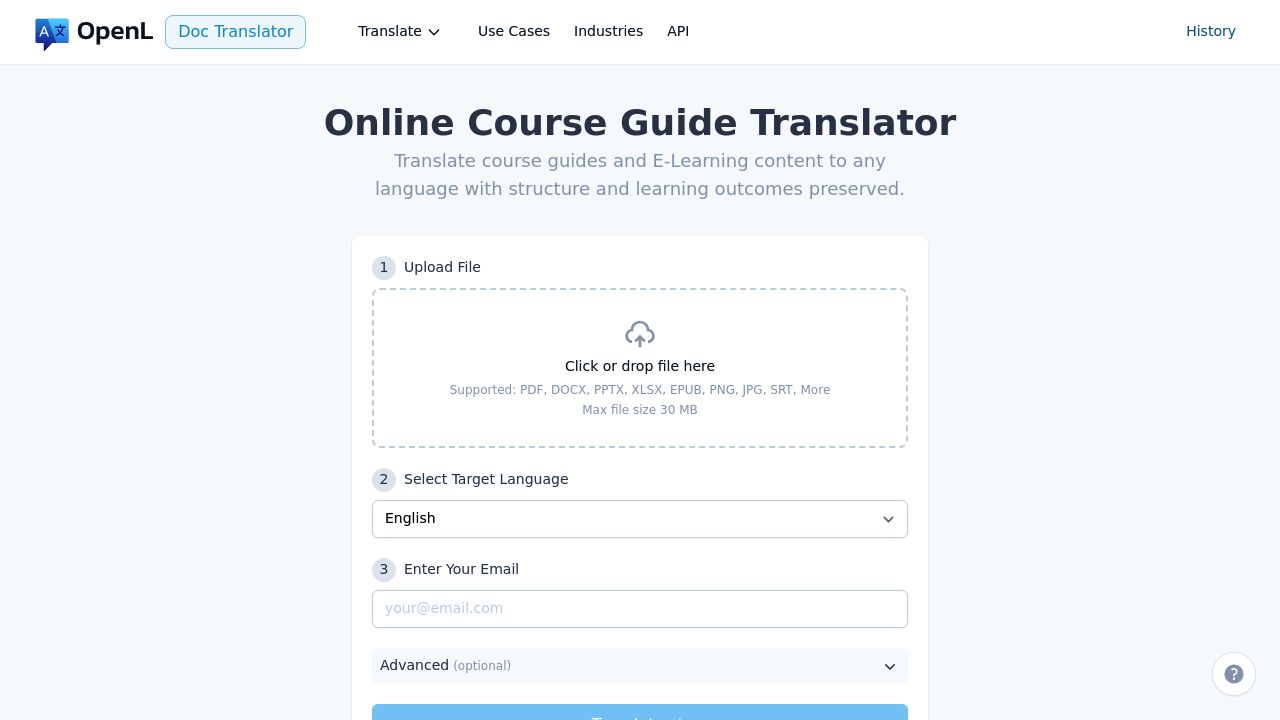
Try it at: 👉 https://doc.openl.io/translate/course-guide
General translation tools
OpenL — Optimized for educational and technical content. Handles academic terminology and specialized vocabulary particularly well. Ideal for syllabi, lecture notes, and papers.
Google Translate — The generalist: 100+ languages, completely free, fast. Good for getting the gist quickly, though translations can feel stilted with complex academic writing.
ChatGPT/Claude with document upload — Translate and explain simultaneously. Ask follow-up questions about confusing sections or request simpler explanations. Interactive capability is invaluable for difficult material.
7. Use your translated guide actively
Before starting:
- Read the full guide once
- Create a week-by-week study plan
- Gather or bookmark all materials
- Review prerequisites if needed
During the course:
- Check the syllabus weekly to see how topics connect
- Track progress by checking off completed topics
- Prioritize required material when time is tight
After completion:
- Keep translated syllabi as a reference library
- Useful when helping others decide if a course suits them
- Share with your language community (respecting copyright)
Conclusion
Translating course guides opens up thousands of high-quality educational resources. The syllabus is your roadmap — once you can read it clearly in your own language, you can navigate the entire course with confidence.
The process takes 10–20 minutes but the clarity lasts throughout your learning journey. You’ll know whether you’re ready, what to prepare, how to allocate time, and what to focus on each week.
Quick Start: Your First Translation
Ready to begin? Here’s a simple 3-step process to translate your first course guide today:
Step 1: Find and Preview (3 minutes)
- Pick a course you’ve been wanting to take (try MIT OCW or Coursera)
- Download the syllabus PDF
- Quickly scan for the weekly topics or table of contents
Step 2: Translate Strategically (10 minutes)
- Upload to ChatGPT/Claude with the prompt: “I want to learn [topic]. Translate this syllabus to [your language] and highlight key prerequisites and requirements”
- Or paste the topics section into OpenL for a quick translation
- Save with a clear filename
Step 3: Create Your Roadmap (5 minutes)
- Make a simple table: Week | Topic | What I need to review
- Note 2-3 questions to research
- Decide: Am I ready to start, or do I need to review prerequisites first?
That’s it. 18 minutes from finding a course to having a clear learning plan.
Suggested Course Sources to Start
- MIT OpenCourseWare (ocw.mit.edu) — Full courses with complete syllabi
- Stanford Online (online.stanford.edu) — Many courses with detailed guides
- Coursera — Often includes downloadable syllabi in course materials
- University course pages — Professors often publish syllabi on their websites
World-class education is waiting for you. Start with one course guide today.