How to Translate Diploma

TABLE OF CONTENTS
The first time I applied to study abroad, I assumed my diploma was “obvious.” It wasn’t. The admissions office emailed back: Please provide a certified translation. Three weeks of scrambling later, I learned that “translation” doesn’t just mean language—it means stamps, signatures, and a process that changes depending on who’s asking.
If you’re applying for a visa, a job overseas, or a master’s program, you’ll likely hit the same wall. Below is what gets accepted, what gets rejected, and how to pick the fastest path that won’t bounce back.
Quick Checklist (Save This)
Before you start, confirm these with the receiving institution:
- ✅ Translation type needed: Certified, notarized, or sworn?
- ✅ Apostille required? Only some countries/documents need it
- ✅ Format: Digital PDF or hard copy with wet signatures?
- ✅ Translate everything: Including stamps, seals, and handwritten notes
- ✅ Certification statement: Must include translator’s name, signature, date, and competency claim
- ✅ Transcript too? Many schools require both diploma and transcript
When Do You Need a Diploma Translation?
Your diploma proves you finished your degree. When someone in another country needs to verify that, they need it in a language they can actually read.
Here are the most common situations:
- Immigration applications: USCIS in the US, IRCC in Canada, and immigration offices worldwide require translated credentials
- Employment abroad: HR might not reject you outright—but they’ll pause your offer until they can verify your degree
- University admissions: Graduate schools need proof your undergrad was real and accredited
- Professional licensing: Doctors, engineers, and lawyers must prove credentials before practicing
- Credential evaluation: Organizations like WES, ECE, and other NACES members need translations before they’ll assess your degree
Example: If your diploma is in Portuguese and you’re applying to a job in Berlin, HR needs an English or German version they can file and verify.
Types of Diploma Translation: What’s the Difference?
Not all translations work for all purposes. Here’s the breakdown:
Rule of thumb: If it’s going to a government office or university, assume you need certification.
Simple Translation (Personal Use Only)
A basic text translation with no official stamps. Useful if you just want to understand what your diploma says. Most immigration offices won’t accept it, and most universities won’t either.
Certified Translation
The most commonly required type. It includes:
- A complete, word-for-word translation
- A signed statement from the translator confirming accuracy
- The translator’s credentials and contact info
In the US, USCIS requires a certification statement like: “I certify that I am fluent in English and [source language], and that the above is an accurate translation.”
Tip: Ask the translator to include the certification on the same PDF as the translation—not as a separate email. Documents get separated during submission more often than you’d think.
Notarized Translation
The translator signs an affidavit before a notary public, who stamps and seals it. Some countries and institutions specifically require this.
Important: Notarization verifies the signer’s identity—not the translation quality. You still need a competent translator.
Sworn Translation
In Germany, Spain, France, and other countries, only government-authorized “sworn translators” can produce official translations. They’ve passed state exams and are registered with courts or ministries.
How to find one: Search “sworn translator + [your city]” or check your country’s official translator registry.
Apostille or Legalization
An apostille is an international stamp that authenticates a document’s origin. For countries in the Hague Apostille Convention, it replaces embassy legalization.
One thing that trips people up: Your diploma itself often isn’t considered a “public document.” In many places, you’ll apostille a notarized copy or a notarized statement about the diploma—not the original. Always confirm the exact steps with the issuing authority.
Certified Diploma Translation Requirements by Country
Requirements change—always confirm with the office that will receive your documents. That said, here’s what typically applies:
United States (USCIS)
For immigration purposes:
- A complete English translation of any foreign-language document
- A certification statement signed by the translator
- Translator’s name, address, and signature
- A statement confirming the translator is competent in both languages
USCIS doesn’t require an ATA-certified translator. But in practice, using a neutral third party is safer—especially if you’re the petitioner—because it reduces back-and-forth questions.
United Kingdom
The UK has no formal “sworn translator” system. But the Home Office and universities usually want translations from members of professional bodies like CIOL or ITI.
The translation should include:
- A statement that it’s “a true and accurate translation”
- The translator’s name, contact details, and date
Canada (IRCC)
For immigration inside Canada:
- Certified translation from a member of a provincial body like ATIO
- Or notarized translation sworn before a notary
If you’re applying from outside Canada, IRCC often accepts a translation plus an affidavit—even if the translator isn’t Canadian-certified.
Germany
Germany requires translations from sworn translators (beeidigte/ermächtigte Übersetzer) registered with German courts. Foreign documents may also need an apostille or legalization.
Australia
For immigration and professional licensing, Australia typically requires NAATI-certified translators. Some documents may need an apostille from the issuing country.
Other Countries (UAE, France, Spain)
Rules vary widely. France and Spain require sworn translators registered with the courts. The UAE often wants documents legalized through the embassy chain. When in doubt, ask the receiving institution first.
Step-by-Step: How to Get Your Diploma Translated
Short version if you’re in a hurry: Confirm what’s required (Step 2), do a draft translation (AI is fine for this), then pay for certified or sworn translation if needed.
Step 1: Prepare Your Document
- Scan your diploma at 300 DPI minimum
- Make sure all text, stamps, seals, and signatures are visible
- Use color scans—they capture red and blue stamps better
- Don’t use phone “document filters” that erase stamp details
If your diploma is a scanned PDF, you might also want to check out how to translate PDF files while keeping formatting.
Step 2: Confirm the Requirements
Before you spend money, ask the receiving institution:
- What type of translation do they accept? (certified, notarized, sworn)
- Do they need an apostille?
- Do they accept digital PDFs or require hard copies?
- Do they also need your transcript translated?
This step alone can save you weeks of back-and-forth.
Step 3: Choose a Translation Service
Option 1: Certified or sworn translator
Best for official submissions. Look for translators affiliated with ATA (US), CIOL/ITI (UK), or NAATI (Australia). For sworn translations, check your country’s court registry.
Option 2: Translation agency
Agencies handle everything—translation, notarization, apostille. More expensive, but convenient when requirements are complex.
Option 3: AI translation for a first pass
If you want to understand your diploma quickly—or sanity-check names, dates, and degree titles—AI can get you 80% there in minutes. OpenL’s Diploma Translator keeps the layout intact, which makes it easier to review before you pay for certification.
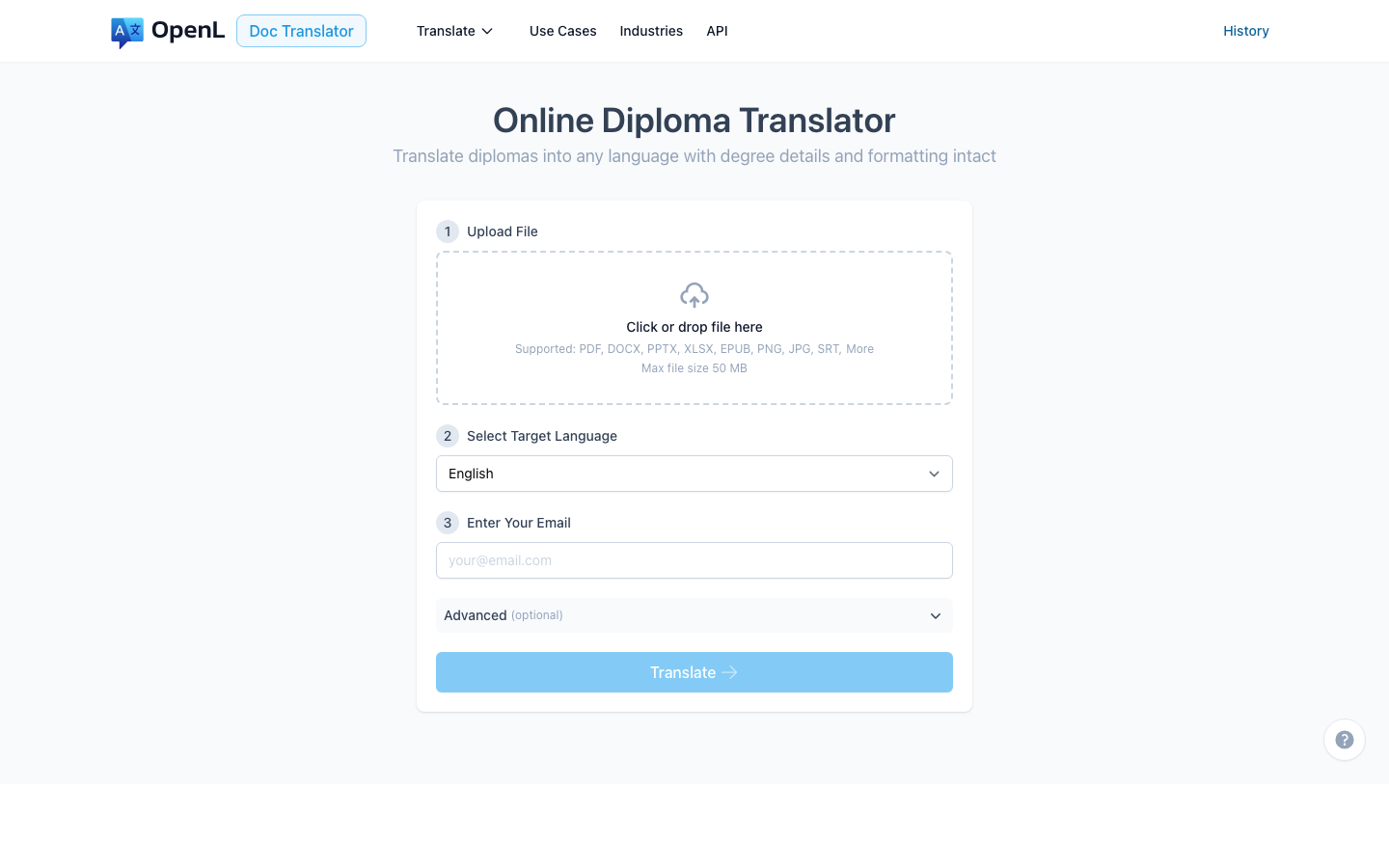
AI is fast, but it can misread seals, abbreviations, and unusual degree formats. Always review carefully.
Step 4: Review the Translation
Before submitting, check:
- All names, dates, and institution names are spelled correctly (I’ve seen “José” become “Jose” and cause delays)
- Degree titles make sense in context (not always literal translations)
- Stamps and seals are noted:
[Round blue stamp: University of X, Registrar's Office] - The certification statement includes everything required
Step 5: Get Additional Authentication (If Required)
Depending on what’s needed:
- Notarization: Take the translation to a notary public
- Apostille: Usually applied to a notarized copy or notarized statement, then submitted to your state or national apostille authority
- Embassy legalization: For non-Hague Convention countries, you may need to go through embassy channels
Common Mistakes That Cause Rejections
Translating degree titles literally
A German “Diplom” isn’t the same as an American “Diploma.” Research equivalent terms, or keep the original in parentheses.
Better approach: “Bachelor of Engineering (Diplom-Ingenieur)“
Forgetting to translate stamps and seals
Official stamps often contain text—institution names, dates, titles. Note them in the translation:
[Oval stamp: Ministry of Education, Republic of X, Accredited Institution]
Using unqualified translators
USCIS allows anyone competent to translate. But WES, universities, and many licensing boards require professional translators. Check before you save $50 and lose weeks.
Confusing certified copies with translations
Some institutions want a “certified copy” (a notarized photocopy of the original) plus a certified translation. These are different things.
Missing the certification statement
The most common rejection reason. Double-check that your translation includes the translator’s name, signature, date, and competency statement.
AI vs. Human Translation: When to Use Which
AI translation works well for:
- Understanding what your diploma says
- Checking names, dates, and degree titles before paying for certification
- Creating a first draft that a certified translator can verify
- Quick turnaround when you need a readable version fast
OpenL preserves your diploma’s layout—helpful when you’re reviewing before the official version.
You need certified human translation for:
- Immigration (USCIS, IRCC, most countries)
- Credential evaluation (WES, ECE, NACES)
- Professional licensing (medical, legal, engineering boards)
- University admissions (most graduate programs)
Pro tip that actually works: Do an AI draft first, then pay a certified translator to verify and certify it. I’ve seen this cut turnaround from days to hours when the translator isn’t starting from scratch. (Note: Some translators or institutions won’t certify a client-provided draft—ask first.)
How Much Does Diploma Translation Cost?
Prices vary by language, urgency, and translator type. Treat these as rough ranges:
| Service | Typical Cost | Turnaround |
|---|---|---|
| Certified translation | $25–$50 per page | 24–48 hours |
| Notarization | $15–$25 per document | Same day |
| Apostille (US) | $35–$100 per document | 2–15 business days |
| Rush service | +50–100% of base cost | Same day or next day |
Real example: Spanish → English, 1-page diploma, certified: ~$30–$40. Add notarization and you’re looking at $50–$60 total.
Frequently Asked Questions
Can I translate my own diploma?
Sometimes. USCIS focuses on the certification statement and translator competence—but many universities and credential evaluators won’t accept self-translation. If the stakes are high (visa, licensing, WES), use a third-party translator.
Do I need an apostille for my diploma?
Only if the receiving country requests it. Apostilles authenticate a document’s origin for Hague Convention countries. Check with the requesting institution.
How long is a translated diploma valid?
Translations don’t expire. But some institutions want documents issued within a certain timeframe (e.g., within 6 months). This usually applies to the certification date, not the translation itself.
What if my diploma is handwritten or damaged?
Scan at the highest quality possible. Note any illegible portions in the translation. For severely damaged documents, contact your university for a replacement or official letter confirming your credentials.
Can WES accept machine-translated documents?
No. WES requires translations that are exact, word-for-word, clear, and completed by a professional translator. But you can use AI to create a draft, then have it professionally certified.